
Rotobrush Air Duct Cleaning in Portola Springs: A Homeowner’s Guide
Any company can say “we use Rotobrush.” The claim is easy to make and hard for a homeowner to check. But the system only works as advertised when the brush head diameter is matched to the duct size and negative pressure is held at the same time the brush is spinning – two steps cut-rate operators routinely skip. This guide is about the technology itself, so you can tell the difference between a real Rotobrush service and a name on a flyer. If you’d rather hand it to a specialist than sort it out yourself, call (844) 685-3117.
How does the Rotobrush system actually work?
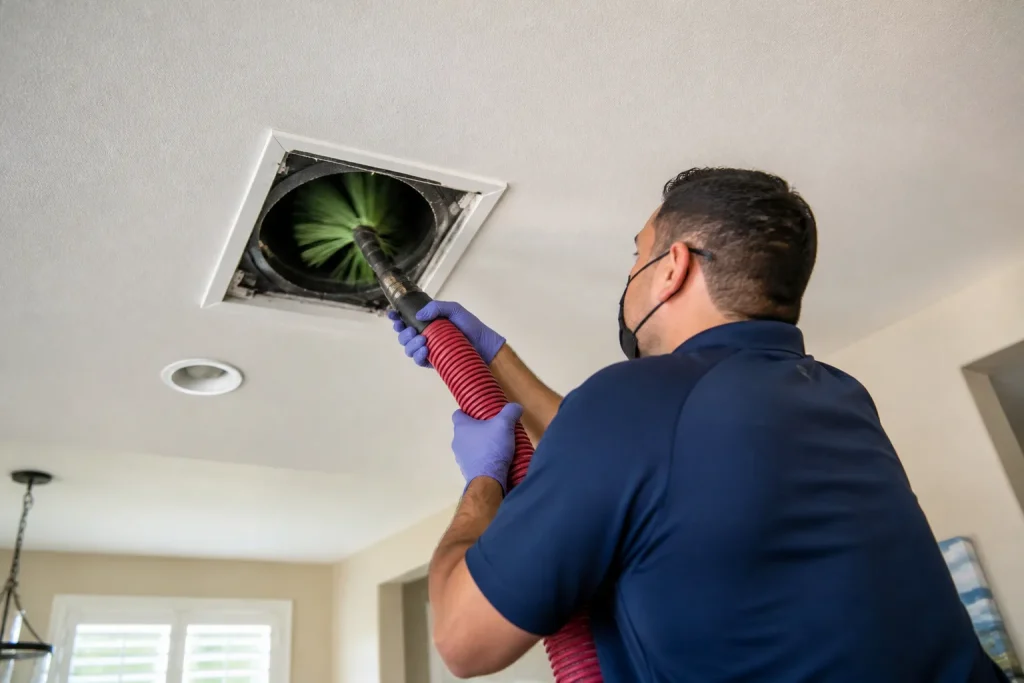
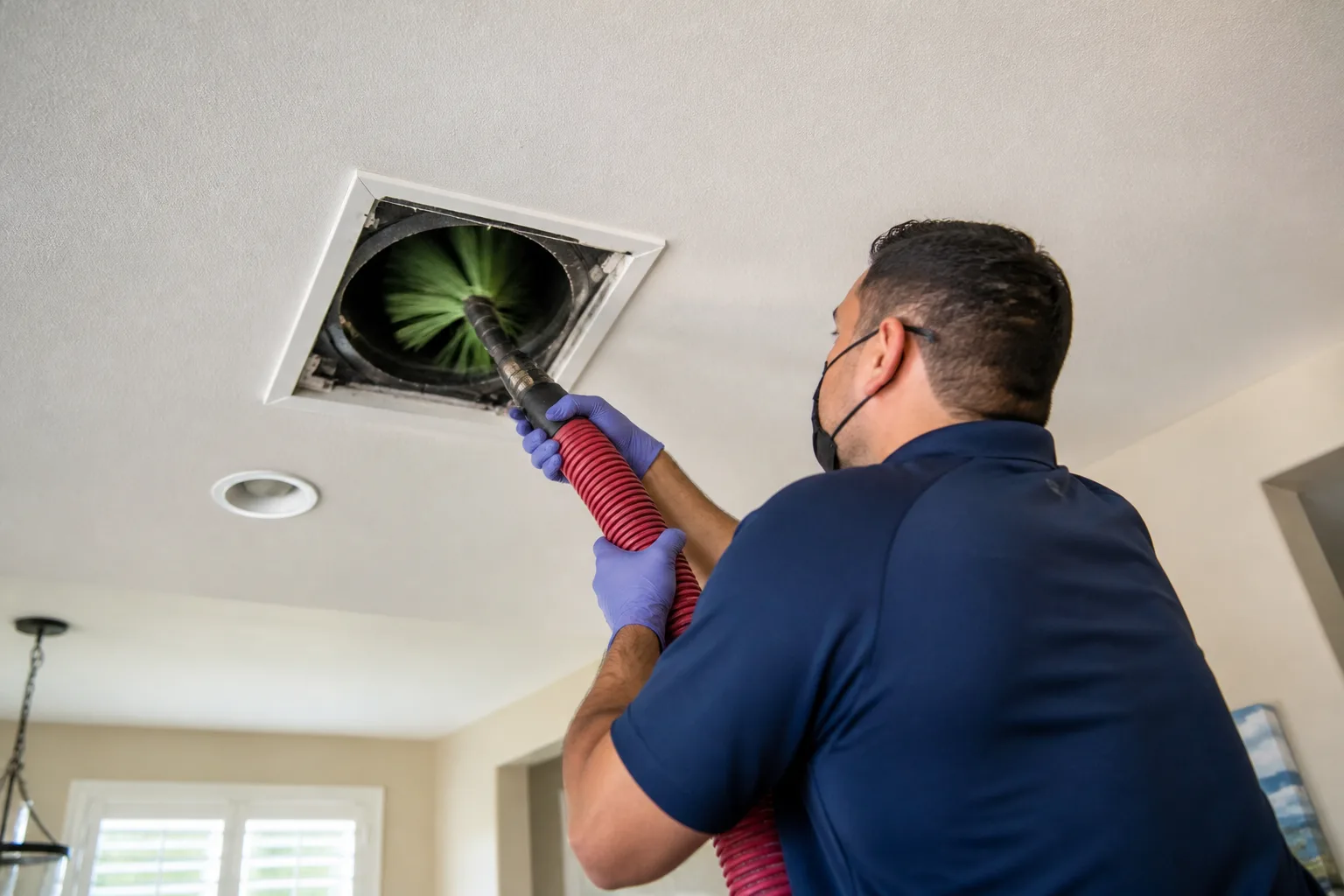
The Rotobrush is a mechanical agitation system built around a rotating brush head attached to a flexible whip, paired with a HEPA-filtered vacuum that runs at the same time. The brush loosens debris from the duct walls while the vacuum captures it in a single, simultaneous pass. That “simultaneous” part matters more than most homeowners realize. Older methods brush a section first, then come back to vacuum it – which means loosened dust gets a chance to settle back onto the walls, drift into the airstream, or escape into the room before anyone vacuums it up.
Here’s what happens in a proper single-pass setup:
- The brush head spins against the duct wall, knocking caked dust, construction debris, and lint free.
- The vacuum pulls air toward the extraction point, so anything the brush dislodges travels one direction – out.
- Negative pressure holds the whole run under suction, which keeps the loosened material from pushing into your living space.
- The debris lands in a HEPA-filtered collection unit, not back in the return air.
When those four things happen together, you get a clean duct. When a technician runs a brush through and vacuums afterward, you get a mostly clean duct and a house that smells like dust for a day. In our experience, that sequencing gap is the single biggest difference between results in Portola Springs homes.
Why does duct material change how Rotobrush is operated?
Rotobrush settings are not one-size-fits-all. The brush pressure and rotation speed have to be calibrated to the duct material, because too much force on a soft duct tears it and too little on a rigid one leaves debris behind. A technician who runs the same aggressive setting through every home isn’t running the equipment correctly.
What proper calibration looks like by material:
- Rigid metal duct – the most forgiving surface. The brush can run at higher speed and firm pressure because the metal won’t deform under it.
- Flex duct – the wire-reinforced plastic spiral is easy to damage. Pressure has to drop and the brush head has to match the duct’s inner diameter closely, or the whip catches on the corrugations and tears the liner.
- Fiberboard duct – the most delicate of the three. Aggressive brushing abrades the surface and leaves fibers behind, so it calls for light pressure and a careful pass.
This is why a technician should look at your ductwork before the brush goes in. Portola Springs homes range from newer builds with flex runs to properties with rigid trunk lines and fiberboard sections, and no two systems take the same approach. A company that skips the inspection step and goes straight to brushing is guessing at your duct material. That’s a bad bet when the wrong setting can damage the system you’re trying to clean.
What does a proper Rotobrush service look like room by room?
A real Rotobrush service follows a sequence, not a random walk through the house. The order matters because each step sets up the next. Here’s how a proper service typically runs in a Portola Springs home:
- Register removal. Supply and return registers come off so the brush can reach the branch runs. Any debris around the register boot gets captured.
- Trunk line access. The technician opens designated access points on the main trunk so the brush and vacuum can reach the full system, not just the visible branches.
- Brush insertion, branch by branch. Each run gets the brush head sized to its duct, worked to the full insertion depth. Short passes that stop halfway leave the far end of the run untouched.
- Simultaneous vacuum extraction. The HEPA vacuum holds negative pressure on the system the entire time, pulling loosened material to the collection point.
- Trunk line and plenum pass. The largest debris loads usually sit here, so the technician works these last with the full extraction running.
- Camera confirmation. Before the registers go back on, the technician runs a camera through the main plenum and trunk lines to show you what was reached.
Room by room, the process follows the ductwork rather than the floor plan. Some rooms take longer than others because their runs are longer or their ducts are more heavily soiled. When a company quoting air duct cleaning rushes through a whole house in twenty minutes, they’ve likely skipped the trunk and plenum work entirely.
Where does Rotobrush fall short, and what supplements it?
Rotobrush is one part of a complete system, not a standalone solution. The rotating brush handles straight runs and gentle bends well. It struggles where ducts turn sharply, where flexible runs double back on themselves, and where debris has compacted into corners the brush head can’t angle into.
That’s where supplemental tools come in:
- Air whips and air skippers use compressed air to blast debris off surfaces in tight bends the brush can’t reach.
- Hand tools and specialty brushes work the sharp corners and short runs where a full whip won’t turn.
- Negative-air containment equipment, which is where our Abatement Technologies units come in, seals off the work zone when a job involves heavier contamination or remediation-grade cleaning.
We also run Nikro systems alongside Rotobrush, because different jobs call for different extraction and filtration setups. If a company only owns one tool and insists it handles every situation, ask what they do when the brush can’t reach a sharp bend. The honest answer involves additional equipment. The dishonest one is “it reaches everything.”
And cleaning is only half the picture. Loose joints, disconnected runs, and gaps at the register boots are why ducts get dirty again in the first place. That’s why we offer air duct cleaning Portola Springs alongside Duct Repair & Sealing – cleaning without sealing the leaks just restarts the clock.
How do you verify the work was actually done?
Before-and-after camera footage of the main plenum and trunk lines is the only reliable way to confirm that mechanical agitation actually reached the debris. Everything else is a claim. The camera shows you the inside of the duct before the brush goes in and the same run after the pass – the difference between a clean duct and a dusty one is visible, not a matter of trust.
What to ask for when the technician finishes:
- Camera footage of the main plenum, before and after. This is the largest, most heavily soiled section and the easiest to verify.
- Footage of the trunk lines, not just the short branch runs. Trunk lines are where the bulk of the debris loads sit.
- Photos of the access points and how they were sealed afterward.
- A written summary of what the camera showed, including any runs the technician flagged for further attention.
If a company can’t produce before-and-after footage, they either didn’t run the equipment properly or didn’t document it. Either way, you can’t tell which – and that’s the problem. We take before-and-after photos of your own ducts, not stock images, so you see exactly what happens inside your system.
When to call a pro
Some of this you can check yourself – register covers, visible dust build-up around the boots, the smell from a return grille. The equipment side is where it gets serious. Rotobrush systems run at high force, and a brush head run at the wrong speed through flex duct can tear the liner, leaving a worse problem than the one you started with. Add the electrical components in your HVAC cabinet and the equation gets simple: the cleaning itself belongs in trained hands. Our technicians have up to 10 years of experience calibrating this equipment to different duct materials, and an experienced operator knows how to match the brush to the duct before it goes in.
Related services in Portola Springs
Duct cleaning works best as part of a broader indoor air plan. We also handle dryer vent cleaning, which addresses lint build-up in a vent most HVAC-only companies never touch, and HVAC cleaning for the air handler and coil side of the system. Air Quality & Sanitizing rounds it out, using Guardsman-line products on duct interiors. If you’d like to expand beyond cleaning into hardware, we install and service Honeywell and Aprilaire products – the same visit can clean the system and upgrade the filtration, rather than leaving you to coordinate two vendors.
The Bottom Line
Rotobrush is a specific mechanical system: rotating brush plus simultaneous HEPA extraction, calibrated to duct material, supplemented by air whips and hand tools where the brush can’t reach, and verified with before-and-after camera footage. When someone says “we use Rotobrush” in Portola Springs, the questions to ask are simple – do you match the brush to my duct material, do you run the vacuum at the same time as the brush, and will you show me the footage when you’re done? If you’re in Portola Springs and need help, Air Duct Cleaning Portola Springs offers free estimates – call (844) 685-3117.
Frequently Asked Questions
Yes, when it’s run correctly. Rotobrush combines mechanical agitation and HEPA vacuum extraction in a single simultaneous pass, so loosened debris gets captured before it can settle back onto the duct walls. A vacuum-only approach removes loose surface dust but doesn’t dislodge caked-on material the way a rotating brush does. The advantage only holds if the operator matches the brush to your duct material and keeps negative pressure running throughout. Call (844) 685-3117 for an exact quote – estimates are free.
It can, if it’s operated without calibration. Flex duct and fiberboard duct require lower brush pressure and matched head diameters; rigid metal duct can take more. A technician who runs one setting through every home is the risk, not the equipment itself. Ask any company how they handle flex and fiberboard before they start. If they can’t answer clearly, that’s your answer. Call (844) 685-3117 for an exact quote – estimates are free.
Most homes don’t need it on a fixed schedule. Visible dust blowing from registers, a musty smell from the return, recent renovation debris, or allergy symptoms that get worse indoors are the signals to watch for. If none of those are happening, you can wait. If two or more are, it’s worth having the system checked. In our experience, homes in Portola Springs with pets or recent remodeling tend to need it sooner than homes without. Call (844) 685-3117 for an exact quote – estimates are free.
Ask for before-and-after camera footage of the main plenum and trunk lines. That footage is the verification – it shows the duct interior before and after the brush pass, so you see whether the agitation actually reached the debris. Register removal and access point photos add context, but the plenum and trunk footage is the proof. If a company won’t provide it, don’t accept the claim. Call (844) 685-3117 for an exact quote – estimates are free.
Contact Us for a Free Estimate
If you’re in Portola Springs and want your ducts cleaned by a specialist who names the equipment and shows the footage, Air Duct Cleaning Portola Springs offers free estimates. Call (844) 685-3117. We answer 24/7. Fast dispatch from 7am to 7pm, Sunday through Friday. One flat price per system is agreed before work starts, the local pro is licensed and insured as their state requires, and the written estimate sets the final price.
Written by the team at Air Duct Cleaning Portola Springs.
Need Air Duct Cleaning Help?
Call Air Duct Cleaning Portola Springs - the local pro we connect you with is licensed and insured, with free written estimates in Portola Springs.
(844) 685-3117