
Top Signs You Need Air Duct Cleaning Service – Don’t Ignore These
Dust on your supply registers is one of the least reliable signs that your ducts need cleaning. Nine times out of ten, visible dust at the vent just means the filter is overdue or the return is pulling from a dirty room. The signals that actually point inside the duct system are subtler, more physical, and consistently missed by homeowners and generalist cleaners alike. Here’s how to tell the difference.
A duct system that’s genuinely contaminated tells you in patterns, not in single spots. The dust settles in a way that tracks back to a source. The smell sticks around after you clean. The airflow is uneven in a shape that matches the layout of the branch runs. Once you know what to look for, the diagnosis gets a lot less mysterious. If you’d rather not climb into the attic to check, call (844) 685-3117 and we’ll take a look.
Filter Neglect vs. Actual In-Duct Contamination: How to Tell Them Apart
The easiest way to know you have a filter problem and not a duct problem: the grime is concentrated at the return and the first few feet of the supply trunk, and the filter itself is loaded. A proper filter change clears most of it within a week. If dust comes back to the same register after you’ve changed the filter and vacuumed the grille, debris has settled further down the run.
What’s physically happening with real in-duct contamination is different. Debris accumulates on the sheet-metal walls of the plenum and the branch runs, held in place by a thin film of moisture and static. The blower keeps pushing air past it, so the light dust picks up particles on the way out and delivers them to your living space. You don’t see the deposit; you see its offspring on your furniture.
- Filter neglect: dust clustered near returns, filter pleats packed, clears after a change.
- Duct contamination: dust returns at the same register, film on the grille face, deeper organic smell.
- Both: filter is loaded and the ducts downstream are coated anyway. Cleaning without correcting the filter does nothing.
Homeowners in Portola Springs often face a third scenario: builder-grade filters that were never matched to the system’s return size. A filter that’s too restrictive starves airflow, and the ducts collect dust because the system is running longer than it should. That’s a filter and duct conversation, not a filter-only one. An air duct cleaning visit tells you which one you’re looking at, because we can see the deposit pattern with a camera and confirm it in person.
Uneven Airflow Room to Room: What the Pattern Actually Tells You
Uneven airflow is normal to a point. A second-floor bedroom runs cooler than a downstairs hallway in any house. What matters is whether the pattern is consistent with the layout or not. If the room at the end of the longest branch run is always the weakest, that’s usually debris accumulation in that specific run: the longer the duct, the more wall area for dust to coat, and the more resistance the air has to overcome.
Here’s the distinction that a lot of service providers get wrong. A closed or stuck damper affects one zone in a way that shows up as still air, not weak air. A failing blower motor affects every room at once. Debris in a branch run shows up as a gradient: the rooms closest to the plenum are fine, the middle rooms are a little soft, the farthest rooms are noticeably weak. You can usually feel it at the register with the back of your hand.
- Duct debris: airflow weakens as you move away from the air handler, in a straight line.
- Damper or balancing issue: one room is dead, others are unaffected.
- Blower or motor problem: everything is weak, and the system runs longer.
- Flex duct kinked or crushed in the attic: one run is weak regardless of room position.
Portola Springs homes with long attic runs and flex duct are especially prone to that last one. A crushed section traps dust at the pinch point and starves the room past it. That’s a repair-and-clean job, not a vacuum-only job, which is why we keep HVAC cleaning and duct repair under one roof. When the ducts are sealed properly after cleaning, the airflow pattern resets to what the system was designed for.
Smells From Your Vents: What Musty, Metallic, and Sweet Actually Mean
A smell from your vents is a physical clue, and the specific smell tells you where the problem lives. “Musty” is the one that gets misdiagnosed most often. Musty air from a supply register almost always means one of two things: biofilm growing on the interior wall of the duct, or standing water in the evaporator coil drain pan. Both need moisture correction before any cleaning makes sense, because a clean duct with a wet pan goes right back to musty in a few weeks.
Metallic smell is different. It’s usually oxidation inside the air handler or on galvanized duct walls where moisture has been sitting. Newer duct systems can have a faint metallic smell for a short while as the zinc coating on the sheet metal offgasses; if it persists, the metal is reacting to something. A sweet or “chemical” smell is the one to take seriously, because it often points to a refrigerant leak or a failing component inside the air handler, and that’s an HVAC repair call, not a cleaning call.
- Musty: biofilm or standing water. Moisture correction first, then sanitizing.
- Metallic: oxidation inside the air handler or duct walls.
- Sweet or chemical: possible refrigerant or component issue. Get it checked before cleaning.
- Dusty or “dry attic”: usually dry debris in the return chase.
When we find biofilm in a Portola Springs duct system, we use Abatement Technologies equipment to contain the work area and keep contaminants from spreading through the house during cleaning, then finish with Guardsman-line sanitizing products on the duct interiors. It’s the same equipment category used in professional mold remediation, which is the point: a musty duct isn’t a “vacuum it out” problem, and treating it like one wastes your money and recontaminates the house. If the smell is persistent, call us at (844) 685-3117 for a free estimate.
Post-Construction Dust: The Portola Springs Trigger Most Lists Miss
Drywall dust is not household dust. It’s calcium sulfate and silica, extremely fine, and it behaves differently in a duct system: it doesn’t just settle, it coats. Microscopic gypsum particles cling to sheet metal and flex duct liners through a static and moisture bond, and once they’re on the surface, the blower keeps pushing air past the coating and lifting a fraction of it into the living space every cycle.
Portola Springs has a lot of newer construction and ongoing renovation. The pattern we see over and over is a home that ran the HVAC system during framing and drywall phase, because the trades needed air, or because the system was commissioned before the interior was finished. The homeowners move in, notice a fine chalky film on the sills and registers within a few weeks, change the filter three times, and still can’t get ahead of it. That’s not a filter problem. The drywall dust is inside the duct walls and the filter is downstream of the contamination.
- New build or major renovation in the last 18 months: high likelihood of construction dust in the ducts.
- Chalky white film on registers and sills: consistent with drywall dust, not household dust.
- Filter changes clear it for a few days, then it’s back: the source is inside the duct system.
- Contractor-grade filter installed during construction: low-MERV, kept the trades comfortable, filtered almost nothing fine.
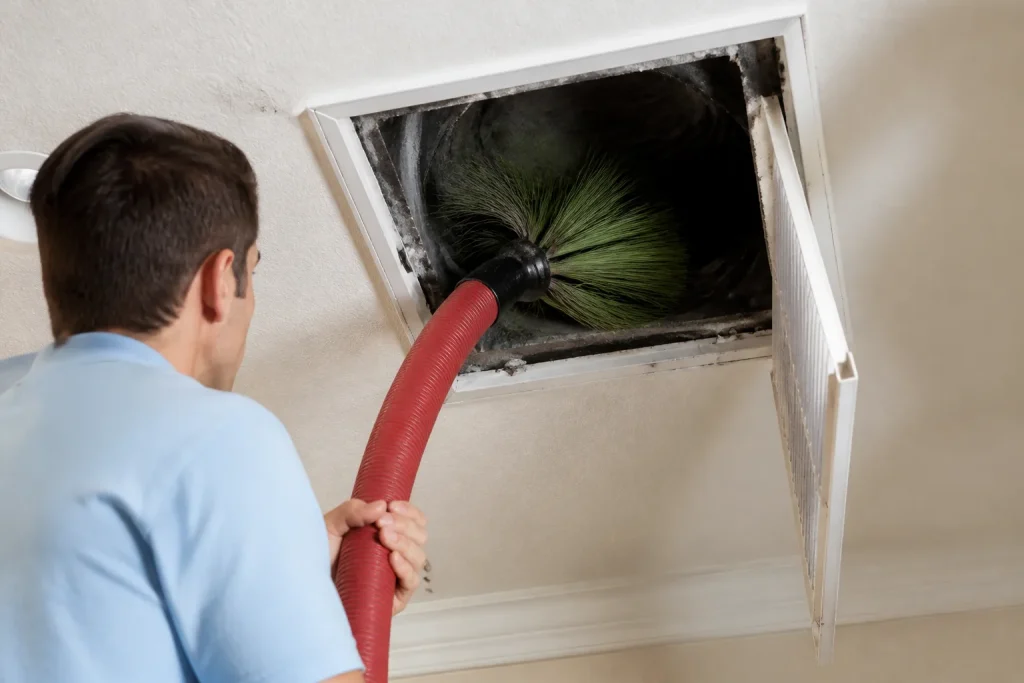
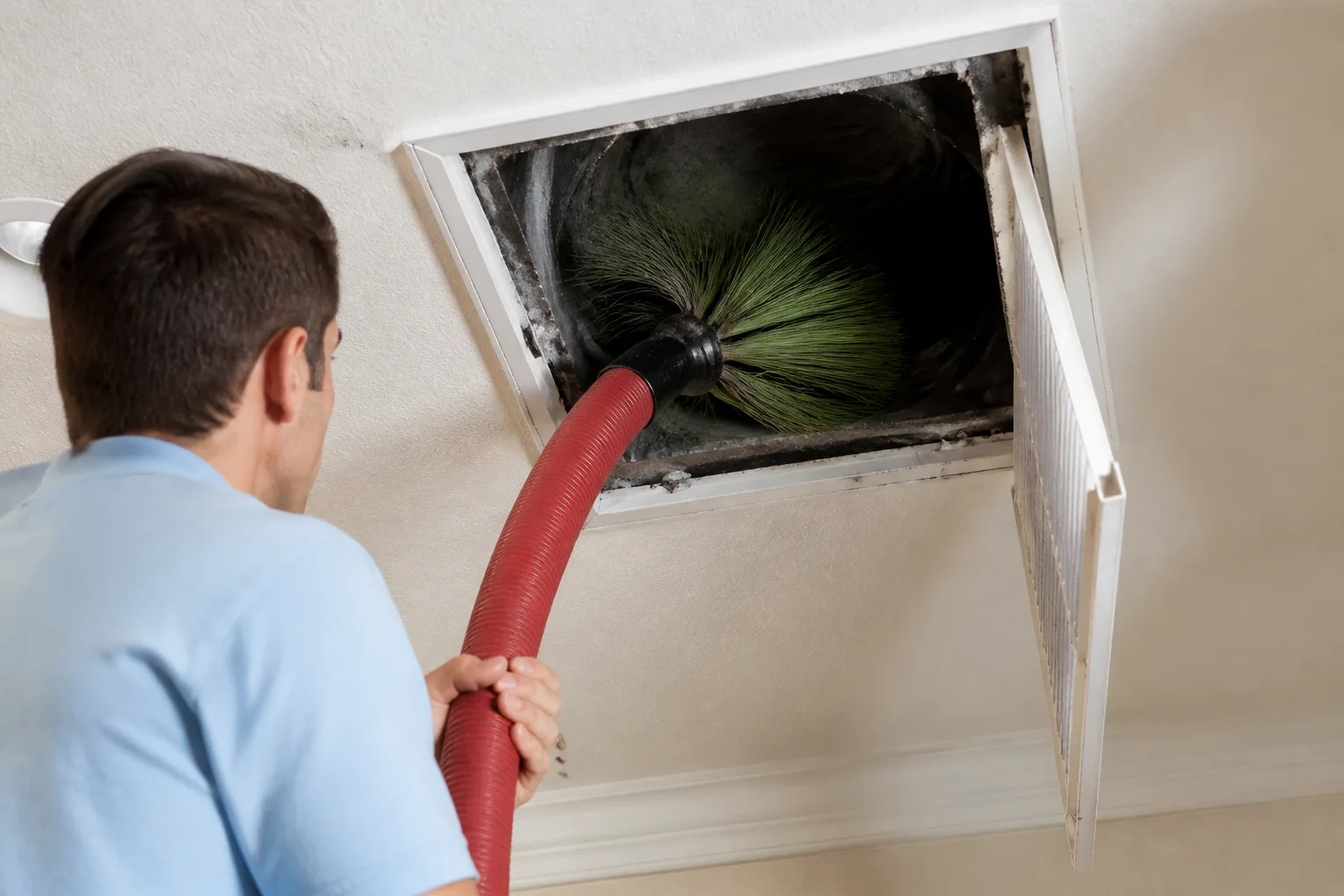
The fix is a proper HEPA-grade cleaning pass, not a shop vac and a compressor. Rotobrush and Nikro systems agitate and extract the duct walls without blowing dust back into the room, and the containment setup matters as much as the vacuum. If you’ve renovated in Portola Springs, ask for a duct inspection before you settle in for the season. It’s easier than living with the chalk.
The Only Objective Test: Particle Counter vs. Outdoor Baseline
All of the signs above are observational. The one verifiable measurement is a particle counter reading inside the living space compared to the outdoor baseline, taken in the same hour with the system running. A hand-held laser particle counter reads the concentration of fine and ultrafine particles per cubic foot, and the ratio between indoor and outdoor tells you whether your duct system is scrubbing or adding particles.
The comparison is what matters. Every house has particulate; the question is whether the supply air is a cleaner or dirtier version of the air the return is pulling in. A properly sealed, clean system with a matched filter will run at or below the outdoor baseline when windows are shut. A contaminated system runs above it, and if you take readings at the register while the blower is on, the gap is hard to miss.
- Take the baseline first: outdoors, upwind of the house, same hour as the indoor reading.
- Measure living space: center of the main living area, system running on fan only.
- Measure at a supply register: this is where contamination shows up most clearly.
- Compare ratios, not raw numbers: the indoor/outdoor ratio is the usable signal.
We bring a particle counter to every applicable Portola Springs estimate for exactly this reason. It’s the difference between “your ducts look dirty” and “your ducts are adding 40% to your indoor particulate load.” The second statement is a diagnosis, and it’s the one that justifies a cleaning. If your readings are inconclusive, we tell you so. Ask for the measurement when you call us at (844) 685-3117.
When to Call a Pro Instead of Guessing
If you’ve changed the filter, cleaned the registers, and the dust or smell is back within two weeks, stop troubleshooting the filter. That pattern is telling you the source is inside the system, and no consumer vacuum reaches it. And if you’ve renovated in Portola Springs in the last year, have a duct inspection done before you settle in.
Related services in Portola Springs: dryer vent cleaning is another system in the same home that collects the same kind of debris, and it’s a fire-safety issue when it does. If you’re already getting the ducts looked at, it’s worth the same visit.
The Bottom Line
The reliable signs you need duct cleaning are not dust on the register. They’re the pattern signs: dust that returns after a filter change, airflow that weakens room by room along the run, a musty or metallic smell that survives a cleaning, and a chalky film that showed up after a renovation. Those point inside the duct system. A particle counter reading against an outdoor baseline is the only objective confirmation, and it’s worth asking for.
Most “signs you need duct cleaning” lists repeat the same filter symptoms and miss the pattern entirely. If you’re in Portola Springs and need help, Air Duct Cleaning Portola Springs offers free estimates – call (844) 685-3117. We answer 24/7. Fast dispatch from 7am to 7pm, Sunday through Friday. Our technicians have up to 10 years of experience, and we bring Rotobrush or Nikro equipment to every applicable job.
Frequently Asked Questions
Most homes need it every three to five years, or right after a renovation or move-in to a new build. The interval depends on the system, the filter quality, and whether anyone in the home has allergies. Portola Springs homes with recent construction deserve an inspection sooner, because drywall dust sits in the duct walls even after the house is finished. Call (844) 685-3117 for a free estimate on your system.
No. Dust on the register face is usually a filter or room-dust problem, not a duct problem. The reliable indicator is dust that comes back to the same register within a week or two of a filter change. That pattern means the debris is inside the duct walls and the blower is lifting it out. Call (844) 685-3117 and we’ll confirm it with a camera and a particle counter reading.
Ask for before-and-after photos and interior camera footage from your own system, and ask for a particle counter reading before and after the cleaning. A crew that used real equipment will happily show you both. Rotobrush and Nikro systems agitate and extract, and the results are visible on camera. If a provider can’t show you what was inside your ducts, that’s your answer. Call (844) 685-3117 for a free estimate with the documentation included.
It can reduce the particle load your system adds to your indoor air, which helps, but cleaning alone isn’t a fix-all. If the ducts are clean and the air handler and filter are right, the next step is air quality hardware. We install and service Honeywell and Aprilaire products because clean ducts are half the answer; filtration and humidity control are the other half. Call (844) 685-3117 to talk through the options for your Portola Springs home.
Written by the team at Air Duct Cleaning Portola Springs.
Need Air Duct Cleaning Help?
Call Air Duct Cleaning Portola Springs - the local pro we connect you with is licensed and insured, with free written estimates in Portola Springs.
(844) 685-3117